
Make your company easier to understand, remember, and choose.
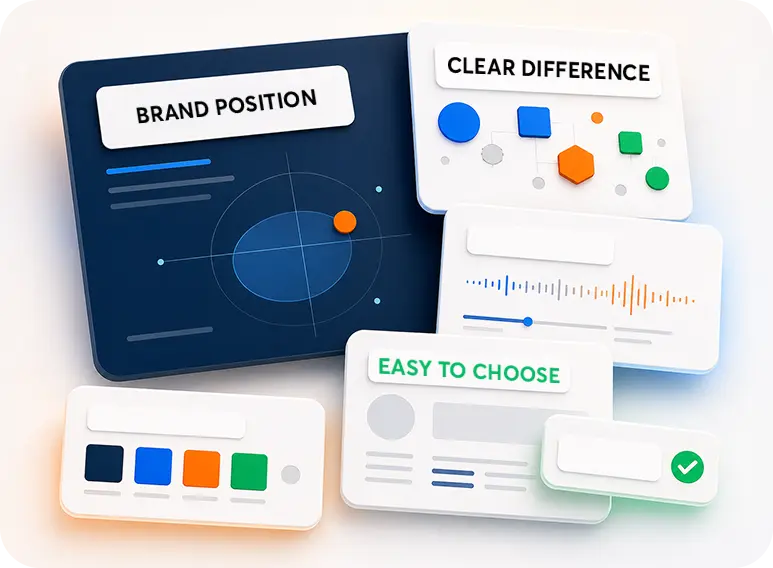
Branding is not just how your company looks. It is how people understand what you do, why it matters, who it is for, and why they should care. We help shape the message, position, voice, and brand system that make your business feel more distinct.
100% of customers are people. To understand business, you have to understand people.
Direct Client Engagements
Companies Supported Through Partner Work
Years of Experience
Specialized Conferences & Industry Ideas
Most branding starts with how it should look. We start with what people need to believe.
The look matters, but the meaning behind it matters more. A strong brand helps your audience understand your value faster, connect emotionally, trust your company, and remember why you are different when it is time to decide.

Understand the People
Every buyer, specifier, contractor, executive, dealer, homeowner, or client is still a person making a decision.

Clarify the Position
We help define where you fit, what makes you different, and why the audience should care.

Shape the Message
Brand messaging should be clear enough to repeat, strong enough to remember, and useful across marketing channels.

Create Momentum
Positioning gives your website, ads, print, social, sales materials, and campaigns a stronger foundation.
Your next best idea may not come from a competitor.
After working directly with 300+ clients and supporting partner work involving 500+ companies across a wide range of industries, we have no doubt there are ideas you have never heard of and your competitors are not using.
1
Cross-industry inspiration creates fresh thinking.
Ideas from one market can unlock smarter positioning, offers, experiences, and campaigns in another.
2
Specialized conferences expand the playbook.
We are always amazed by how ideas from niche industries can be adapted for completely different businesses.
3
Competitors often copy the same category habits.
Looking beyond the industry helps you avoid sounding like everyone else in the same lane.
4
Fresh perspective can make the obvious feel new.
Sometimes the strongest brand move is taking a familiar truth and presenting it in a more memorable way.
We have worked with consumer brands, industrial clients, and the full chain between them.
Some brands need to hit on the individual level. Others need to influence everyone from a sales rep selling to a local contractor to a national campaign for a large enterprise. We think through the full chain of people who need to understand and trust the message.
Consumer Brands
Individual-Level Connection
Messaging that meets people emotionally, practically, and personally.
Local Buyers
Trust Near the Sale
Positioning that helps prospects feel confident enough to call, visit, request, or buy.
Sales Channels
Rep-to-Contractor Clarity
Materials and messaging that help someone else explain the brand well.
Enterprise
National Campaign Thinking
Brand systems that can scale across regions, teams, materials, and larger market goals.
Branding should make the business easier to explain and harder to forget.
Positioning does not have to be abstract. It should show up in the words, visuals, offers, website sections, ads, sales materials, presentations, and customer conversations that represent your company every day.
Messaging
Core Brand Message
Define the simple statement or idea that helps people understand what you do and why it matters.
Position
Market Differentiation
Clarify where you fit, what makes you different, and why your audience should choose you.
Voice
Brand Personality
Shape how the company should sound across website copy, ads, sales materials, and presentations.
Audience
Buyer Understanding
Think through what your audience wants, fears, values, compares, and needs to believe.
Proof
Reasons to Trust
Identify the evidence, experience, story, process, or outcomes that support the brand promise.
Campaigns
Theme Development
Create campaign ideas and creative angles that make the brand easier to remember.
Visuals
Design Direction
Connect messaging to colors, layout, imagery, typography, and the overall brand feel.
Sales
Conversation Support
Help sales teams, websites, and marketing materials explain the company with more confidence.
100% of customers are people.
Business strategy often sounds like it is about markets, segments, industries, and channels. Those things matter, but every decision still comes back to a person deciding whether they understand, trust, like, remember, or believe the company in front of them.
1
People want clarity.
If your brand is hard to explain, people have to work too hard to understand why it matters.
2
People respond to proof.
Strong positioning should be supported by evidence, examples, experience, process, or credibility.
3
People remember stories.
A compelling brand idea gives the audience something more memorable than a list of services.
4
People need confidence.
The brand should make the next step feel easier, safer, smarter, or more worthwhile.
Positioning should travel through every touchpoint.
The best brand strategy does not stay inside a document. It should help the company sound clearer, look stronger, and communicate more consistently across the places people actually encounter the business.
Step 1
Understand
Clarify the audience, offer, market, story, and goals.
Step 2
Position
Define what makes the company distinct and worth choosing.
Step 3
Message
Shape the words, themes, proof points, and brand voice.
Step 4
Express
Carry the brand into web, ads, print, sales, and campaigns.
Step 5
Evolve
Refine the brand as the business, audience, and market grow.
Strong positioning connects strategy, message, design, and action.
Branding is not one headline, one logo, or one moodboard. It is a system that helps your audience understand what makes the company different and gives your marketing a direction to build from.
Discovery
Business Context
Understand the company, audience, industry, offers, competitors, and current perception.
Perspective
Cross-Industry Ideas
Bring relevant ideas from other markets, conferences, campaigns, and client experiences.
Position
Strategic Differentiation
Clarify what the company should be known for and why that matters to the audience.
Message
Brand Language
Shape taglines, headlines, website voice, sales language, and campaign themes.
Audience
Decision Psychology
Consider the people who influence, recommend, approve, buy, sell, or use the product or service.
Visuals
Brand Direction
Connect the positioning to color, typography, design style, imagery, and layout approach.
Application
Marketing Touchpoints
Extend the brand into websites, ads, print, social, proposals, presentations, and trade shows.
Momentum
Ongoing Evolution
Keep refining the brand as the company, market, audience, and opportunities grow.
A practical path from discovery to stronger market presence.
We make branding easier by turning abstract questions into clear strategy, useful language, visual direction, and practical marketing applications.
01
Learn the Business
Understand the company, customer, market, story, competitors, and current challenges.
02
Find the Angle
Look for the truth, idea, promise, or perspective that makes the brand more interesting.
03
Shape the Position
Define where the company fits and why people should care.
04
Build the Message
Create the language, themes, proof points, and brand voice.
05
Connect the Visuals
Translate strategy into design direction, campaign feel, and brand expression.
06
Apply the Brand
Carry the direction into websites, ads, print, sales materials, and future campaigns.
Brand strategy can be a standalone project or the foundation for a larger build.
Some businesses need positioning and messaging first. Others need a full brand rollout into logo design, website copy, ad campaigns, print materials, trade show displays, presentations, and ongoing creative support.
Strategy
Brand Positioning
Define what you should be known for and how your audience should understand you.
Message
Messaging Framework
Create headlines, taglines, core message, service language, and proof points.
Voice
Brand Voice Direction
Shape how the brand should sound across web, ads, print, sales, and presentations.
Visual
Creative Direction
Guide colors, typography, image style, layout feel, and design personality.
Identity
Logo & Brand Assets
Pair positioning with logo work, brand files, and visual identity updates.
Website
Website Story & Copy
Turn brand strategy into homepage sections, service pages, and conversion copy.
Campaigns
Ad & Campaign Concepts
Develop angles that make the brand more memorable across paid and organic channels.
Sales
Presentation Materials
Support proposals, sales decks, brochures, print collateral, and leave-behinds.
We bring ideas from everywhere, then shape them around your business.
After direct work with 300+ clients, partner-supported work involving 500+ companies, and countless specialized conferences, we have seen ideas from every industry imaginable. The value is not copying those ideas. It is knowing how to adapt what fits, discard what does not, and build a brand direction that feels true to you.
Broad Perspective
Ideas from consumer, industrial, local, regional, and national brand challenges.
Human Understanding
Messaging shaped around how people think, trust, compare, and act.
Full-Service Application
Positioning that can flow into websites, ads, print, AI, tools, and campaigns.
Branding decisions are easier when expectations are clear.
These quick answers help explain positioning, messaging, visual direction, brand refreshes, and how strategy can support future marketing.
Is branding only about logos and colors?
No. Logos and colors matter, but branding also includes positioning, messaging, audience understanding, brand voice, proof points, visual direction, and how the company should be understood across every touchpoint.
Can you help if we already have a logo?
Yes. Branding and positioning can clarify the message, update the voice, improve consistency, and shape stronger campaigns without necessarily replacing the logo.
Why look outside our industry for ideas?
Competitors inside the same industry often repeat the same ideas. Cross-industry thinking can reveal creative approaches, campaign structures, offers, and messaging angles that your audience may not have seen before.
Can branding help industrial or B2B companies?
Yes. Industrial and B2B brands still sell to people. Positioning can support everyone from reps and contractors to distributors, executives, buying committees, and national campaign audiences.
Can this lead into website copy or ad campaigns?
Yes. Branding and positioning often become the foundation for website copy, service pages, ads, direct mail, print collateral, trade show materials, sales presentations, and social creative.
Do you provide a final strategy document?
Depending on the scope, we can provide messaging frameworks, brand direction, positioning notes, voice guidance, campaign themes, and practical recommendations for applying the strategy.
Not sure which service you need?
Use the green “Ask me Anything” button in the corner to get campaign ideas, strategy guidance or answers about our business instantly. Our AI assistant is not a replacement for a real strategy conversation, but it might surprise you.